
Yoga therapy · Lower Mainland & the Pacific coast of BC
You’re not bad at yoga. You were given the wrong practice.
Thirty years reading bodies under pressure, on the mat and on the table.
For women who’ve done the classes, the physio and the stretching routines, and still don’t feel at home in their bodies. In person and online.
If this is you
You’ve been doing the work. It just hasn’t been the right work.
Most people find me because something broke. A shoulder, a back, a hip that stopped cooperating. You’ve done the physio. You’ve done the classes. You showed up, followed the cues, held the poses… and your body is still telling the same story.
That isn’t a failure of effort. Most yoga is taught as a cookie-cutter, Simon Says class: the same poses, the same way, for every body in the room. Nobody is looking at your fascia. Nobody is asking about your spine, how your joints carry load, or whether your tissues are hydrated enough to move lymph. And nobody is working with the other seven limbs of yoga, the ones that nourish the mind and spirit along with the body.
Here’s the part nobody tells you: your brain wants to keep you comfortable, even when you’re not safe. So you keep doing what’s familiar.
The same class.The same stretch.The same bad side.
If that sounds like you, dear one, you’re in the right place.
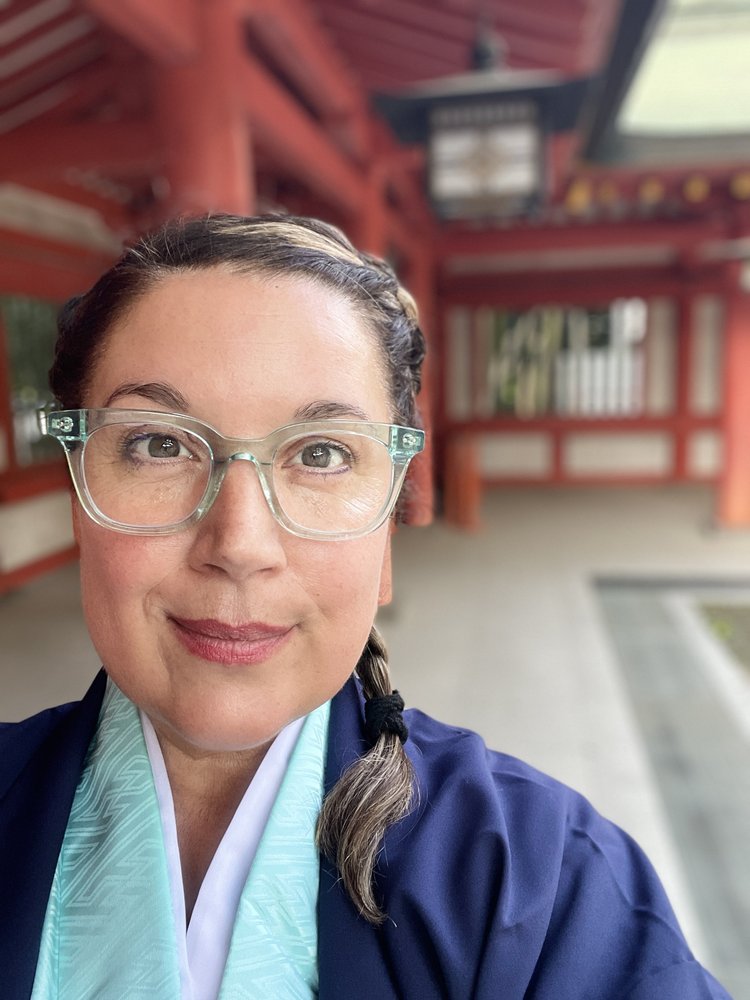
Meet Diane
I’m Diane Seamark, and I don’t teach cookie-cutter yoga.
I did yoga for the first time on Galiano Island. I was 19, and it was the first time I felt I could control how my body felt. I have endometriosis, and my periods were devastating. That practice showed me I could feel safe in my body, and that I could make it feel better. I practised for three years before I certified to teach in 1997.
For years, a few hours after practice, I’d turn cagey and bitchy for no reason I could name. Now I have a name for it: somatic sludge.
In 1999, a head-on collision on the Lions Gate Bridge left me with four herniated discs. I rehabilitated them.
For thirty years I’ve read bodies in two rooms. On the mat, with an opponent, where the pressure is live. On the table, with a client, where the pressure is stored.
I hold Kaiden Shihan Kogyoku in KoKoDo JuJutsu, 5th Dan, the martial arts equivalent of a doctorate. I’m one of two women in the world to hold Kogyoku, and the first outside Japan. I’m also a Certified Yoga Therapist and Shiatsu Practitioner, teaching since 1997, with more than 8,500 hours. The mat taught me where a body braces, where it compensates, and what it’s protecting. The table is where I help it let go. Yoga therapy, in its essence, is a personal protection skill.
For eight years I was the in-house yoga therapist at CBC, and I held the same role at the Labour Relations Board of BC.
Credentials & career
- 2025Author, Gut Punch: Is It Trauma or Intuition?About the book
- 2024Received Menkyo Kaiden Kogyoku, KoKoDo JuJutsu5th Dan
- 2024Blue Belt, Ribeiro Jiu-Jitsu
- 2021Certified BodyMind Coach
- 2011Certified Yoga Therapist
- 2008Certified Meditation Teacher
- 2002–2007In-house yoga therapist, Labour Relations Board of BC
- 2001–2009In-house yoga therapist, CBC
- 2001Certified Shiatsu Practitioner
- 1999Certified Pre & Postnatal Yoga Teacher
- 1998Certified Ashtanga Yoga Teacher
- 1997Certified Hatha Yoga TeacherBegan teaching. 8,500+ hours since
- 1995Nursing assistant, Foothills Hospital
Trauma-informed. My work draws on somatic experiencing (Peter Levine).
Now I work one-on-one as a yoga therapist across the Lower Mainland and the Pacific coast of BC, so your practice finally fits your body.
What working with me looks like
On the mat, on the table, in life
On the mat
We go slowly. I would never teach headstands in someone’s first yoga class, and I’d never teach ground fighting in a first jiu-jitsu class. We start slowly, gain momentum, back off, and re-approach. Slow is smooth, and smooth is fast.
On the table
You don’t just do tree pose. You redistribute your weight through the metatarsals, condition the ankles, lift out of the hips, and tone the pelvic floor. The pose is secondary. Changing the stress pattern is the goal: hydrating fascia, strengthening stabilisers, and learning how your joints carry load.
In life
It goes home with you. PEMS hygiene, a daily check-in across the physical, emotional, mental and spiritual, keeps the change going between sessions. Self-protection is the ultimate self-care.
A body in a stress pattern is like a garden hose coiled all winter. Uncoil it and it snaps back. It takes consistent movement, breath and time to set a new pattern.
Our minds can change our bodies. Our bodies can change our minds. Our behaviour changes the outcome.
Most sessions happen at my dojo. Online works too: a clear bit of floor is all you need, and if a kitchen chair is what you’ve got, or your mobility is limited, we start from there. In-home sessions are occasionally available.
Three steps
How we start
- 1
Start free
Get the SI joint guide and feel the difference in your own body.
- 2
Book the Body Brief
A free 10-minute call to check we’re a fit, then one 120-minute session. I assess how your body moves and what it’s protecting, and you leave with a practice built for you. See the Body Brief
- 3
Feel it
“I feel better than I have felt in years.”
Mark’s story
Mark came to me after eight months of physio. At physio, he was handed the exercises and left to do them on his own.
With me, I stood with him through every new movement and corrected imbalances on the spot. We didn’t just work the injured part. We worked everything around it, because the body only works as a whole.
In their words
I didn’t realize this is what yoga therapy was.
Rachel You brought mobility to my shoulders where five years of physio didn’t.
Mary I have no age on the mat.
Darryl I feel more rested than a full night’s sleep after your session.
Jason The awareness is capital A on steroids.
Charolette
Off the mat
I’ve tried it all.
Sweat lodges· Holotropic breathwork· Angel workshops· Vipassana· 5Rhythms· Cold plunges
Some of it stuck. A lot of it didn’t.
I teach what works from what I know to be true.
And I still get tapped.
I’m a blue belt in Ribeiro Jiu-Jitsu, a beginner again in a room where nobody cares what Kogyoku is. It keeps me honest about what it feels like to be in a body that doesn’t know what to do yet.
Start here · Free guide
One of the most common cues in yoga is quietly damaging your SI joint.
Find out which one, and what to do instead. The guide goes straight to your inbox.
Ready for the full picture?