
Is This Intuition or Anxiety?
"Trust your gut" is bad advice for a nervous system still in survival.
You have probably been told to trust your gut. You have probably also been told your anxiety makes you see danger where there is none. So now you're standing there with a body full of information and no idea which advice to follow. Is this intuition or anxiety?
Your stomach tightens. Something about this person, this invitation, this conversation doesn't feel right.
Then the negotiations begin.
Am I overreacting? Am I picking up on something? Is this my past getting in the way of something good?
I know that place. For decades I berated myself for not listening to my gut, or for trusting it and realizing, too late, that I had made a bad call.
Here's the hard part: the answer does not arrive on its own. Terribly unsatisfying to read, I know. But there is a way to find out. It starts with knowing what real danger feels like, so you can recognize an old alarm when it goes off.
What real threat feels like
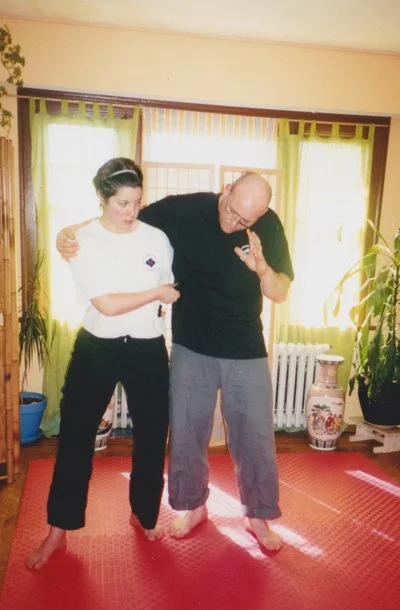
I have spent thirty years on the mat, and the mat doesn't lie.
When someone comes at you in a live round, your body answers before your mind has formed a sentence. Your weight drops. Your hands come up. Your eyes go to the hips and shoulders, because that's where the tell is. There is no negotiating, no "am I overreacting?" There's no time for it.
Real threat is specific. It is happening now, in front of you, at a particular distance and a particular speed. Your body reads timing, distance and pressure, and it responds to what is actually there.
And even then, you get it wrong. I still get tapped, at my rank, by people half my age. You telegraph something, you misread a tell, you're half a second late. The mat teaches you that a signal can be real and your reading of it can still be off.
Now compare that with the tightening in your stomach at a café table, or the dread before a phone call. Nobody is closing distance. Nothing is coming at you. And still the body braces as if something is.
That gap, between what your body is doing and what is in front of you, is where the question lives.
The name that put me on guard
There was a boy in the trailer park where I grew up who terrorized me for years. He mocked me, embarrassed me, and assaulted me. Long after those encounters, meeting someone with his name could bring a familiar reaction: apprehension, a tightening, a wary withholding.
Imagine calling that intuition every time it happened.
A new person introduces himself, and my body responds before I have learned anything meaningful about him. My stomach tightens. My jaw clenches. If I take that response as proof of his character, I might mistake recognition of a name for knowledge of a person.
The feeling was real. So was the history behind it. The question was whether that history told me anything about the person standing in front of me.
It didn't. It told me about the trailer park.
Recognizing the association gave me something to work with. I could acknowledge why I felt guarded and still pay attention to how this particular man behaved. I didn't have to force myself to trust him. I didn't have to distrust him either. I had to give myself room to learn what was actually there.
This is one way the past interrupts the present. Trauma reminders can be people, places, sounds and smells, and they can bring old distress into a situation that is nothing like the original one.[1]
What most people call anxiety is often exactly this: a stored survival response. It's an alarm your body learned for good reason, going off in a room the danger has already left.
Trauma is a stored survival response. Not an identity. Not a verdict on who you are.
That does not make you foolish. It means your gut was trained by more than one teacher, and not all of them told the truth.
How do you tell intuition from anxiety?
Here's my tell. It took me years to trust it.
Intuition is quiet. It's a nudge, a small knowing that sits somewhere between what you can explain and what you can't. It rarely arrives with panic, a racing mind or a flood of what-ifs.
A stored survival response is loud, or it's familiar. It comes with chaos, spinning and bracing. Or it comes with that "oh… this again" feeling of recognition.
Familiar is the tell.
Your chest goes tight when he texts. That could be your body telling you something true about him. It could also be your body telling you something true about your past. Here's how you find out. In the moment, ask:
Is this quiet, or is it loud?
Is this new, or have I felt this exact thing before? What was happening then?
What do I actually see in front of me, and what am I predicting?
What would give me more information, or more room to choose?
The third question does the heavy lifting. Separate what you observed from what you think it means.
"She asked me three times after I declined" is an observation. "She will punish me if I disappoint her" is a prediction. That prediction may come from your history with her, from your history elsewhere, or from both. Making the distinction gives you a place to begin.
Get specific about the sensation. "My throat feels tight" gives you more to work with than "This is bad." So does "I feel an urge to agree quickly" or "I'm holding my breath." Then look at what happened just before it. A change in someone's tone? A request you didn't want to fulfil? A name, an expression, a familiar kind of pressure?
Drill it when nothing is at stake
You don't learn a break-fall in the middle of a car accident. You drill it until it's boring, so it's there when you need it.
Your signals work the same way. I call it PEMS Hygiene: the daily practice of checking in with your physical, emotional, mental and spiritual states, which ebb and flow. And yes, that includes the uneventful days when no hard decision is waiting.
This is where you cultivate discernment. Each of those four levels logs impact and stores memory. When that stored material starts to move, in a class, a session or a hard conversation, you get somatic sludge.
What does tired feel like in your body? What happens when you're excited? When do you rush to accommodate someone? What helps you notice your own preferences before you've already said yes?
A journal gives you somewhere to track sensations, what prompted them, and what happened when you responded. The point is to become familiar with your own experience, without turning every encounter into a test you have to pass.
The honest part
Sometimes it's both. An old alarm can go off in a room where something really is wrong.
Sometimes your first reading holds up. Sometimes new information changes it. Sometimes you never find out what would have happened, and your choice can still have been reasonable.
And you can't do all of this alone in a notebook. You can't fully rely on your instincts until they're the right instincts, and getting there takes other people: a friend, a teacher, a practitioner, a training partner who reflects back what they see. A nervous system can't fully check its own work.
That isn't failure. That's discernment.
Where to begin
Dear heart, you do not need to become perfectly calm before your voice counts. And you do not need to treat every uneasy feeling as a prediction.
You can take yourself seriously while remaining curious about what you feel.
That is where I would begin: with enough respect for your own experience to listen, and enough room to learn what it means.
If you want to go deeper, that's what my book Gut Punch is for.
[1] National Child Traumatic Stress Network, "Trauma and Loss Reminders." https://www.nctsn.org/resources/trauma-reminders-infographic
